

Can Labour Trends Reveal Your Next Big Business Move?
June 6, 2025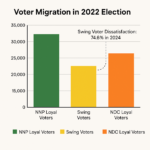
The Returning Tide: The Case of the 3,500 NNP Supporters Who Voted NDC in 2022
June 16, 2025
Photo credit goes to ( The New today Newspaper 2022 )
Analysis of Grenada’s Political Landscape: June 2025
By Dr. Justine Cleophas Pierre: Labour Market consultant
Email: cjustinepierre@gmail.com
Introduction : Grenada’s Political Landscape Heats Up Ahead of 2026 Election
As Grenada approaches the mid-point of the electoral cycle, the political climate intensifies, particularly on digital platforms. The New National Party (NNP) has shown significant momentum, with its social media performance surpassing that of the ruling National Democratic Congress (NDC) for the first time in two and a half years. This shift indicates a growing appetite for political change among key voter segments and suggests that the opposition is successfully leveraging digital outreach to re-engage the electorate.
Prime Minister Dickon Mitchell continues to command a strong personal approval rating, maintaining a 67% likability score, though this has dipped four points since April 30. While Mitchell remains the most influential political figure online, his popularity alone may not be sufficient to carry the NDC through another election cycle, especially if the party does not address internal weaknesses and public dissatisfaction. His communications strategy and visibility remain effective, but recent controversies and limited grassroots connections are eroding public confidence.
Meanwhile, Emmalin Pierre, the newly appointed political leader of the NNP, is gaining ground. Her social media influence has risen to 55%, a record high since taking the reins of the party. Over the past quarter, her digital presence grew by 11%, with a 7% spike in the last 30 days alone. This growth signals renewed public interest in her leadership. It suggests that she may be galvanising traditional NNP support bases and undecided voters disillusioned with the current administration.
Other political entities, such as The Movement, the People’s National Party (PNP), and the Grenada United Labour Party (GULP) remain on the political margins, with combined social media traction below 6%. Their limited digital engagement and organisational visibility make it unlikely they will emerge as serious contenders in the near term. Within the NDC itself, only a few figures, namely Prime Minister Mitchell, Andy Williams, and Ron Redhead, register notable public influence online, further highlighting the party’s limited bench strength and communication reach.
According to projections by Dunn Pierre Barnett and Company Canada Ltd., the National Democratic Congress (NDC) is more likely to retain a competitive edge if general elections are held before December 2026. However, should elections be delayed beyond November 2026, the shifting political momentum may favour the New National Party (NNP) or emerging political movements. Grenada’s political landscape is rapidly evolving, with the battleground increasingly shifting from traditional community outreach to digital platforms. In this context, maintaining a robust online presence and executing strategic, data-driven engagement campaigns will be essential. Continued monitoring, coupled with agile and responsive communication strategies, will be critical for any political party seeking to connect meaningfully with a discerning and digitally engaged electorate..
1. Electoral Dynamics: The Myth of Partisan Loyalty
Grenada is traditionally defined by its two-party structure, the NNP and the NDC. However, the reality is that the electorate operates as a No Loyal Party (NLP) system. Voters are not ideologically rigid; they are performance-driven. Approximately 5,000 to 7,000 swing voters routinely determine electoral outcomes, shifting allegiance based on policy delivery, transparency, and leadership style. In the last 30 years, while the NNP accumulated over 200,000 votes, the NDC trailed at approximately 170,000, demonstrating the NNP’s consistent ability to mobilise its 30,000-strong base, compared to the NDC’s 22,800.
This statistical gap places the NDC at a permanent electoral disadvantage unless it activates new voters, regains disillusioned supporters, and addresses internal deficiencies that hinder campaign effectiveness.
2. The 2022 Election: Protest, Not Endorsement
The 2022 general elections in Grenada marked a pivotal moment in the nation’s political trajectory, not for what they embraced, but for what they rejected. The landslide victory secured by the National Democratic Congress (NDC) was not the result of widespread enthusiasm for a transformative policy platform or profound ideological realignment. Instead, it was a resounding protest vote against the long-dominant New National Party (NNP), signalling a citizenry disillusioned with the status quo and desperate for accountability, inclusion, and dignity in governance.
For nearly two decades, the NNP maintained a firm grip on Grenadian politics under Dr. Keith Mitchell’s leadership. While credited with economic stability, infrastructural development, and fiscal conservatism, the party also became synonymous with political opacity, alleged cronyism, and stagnation in crucial areas of social justice. By 2022, Grenadians were not just seeking new policies; they were demanding a new political culture. This discontent manifested in key issues that resonated with broad population segments.
First, the government’s failure to implement meaningful pension reform became emblematic of broken promises and systemic neglect. Retired public servants, many of whom had dedicated decades to national service, felt betrayed by the state’s inability or unwillingness to deliver the financial security they had long been assured. Their frustration echoed across generations, especially as the economic aftershocks of the COVID-19 pandemic exposed vulnerabilities in Grenada’s social protection systems.
Second, the so-called “reform agenda,” touted by the NNP, was criticised for lacking clarity, coherence, and tangible results. For many voters, it appeared more like rhetorical packaging than a substantive economic and social renewal roadmap. Combined with concerns over the slow pace of converting temporary government workers into permanent staff, this created a widespread sense of institutional fatigue. Thousands of Grenadians employed under temporary contracts were effectively trapped in limbo, denied long-term job security, upward mobility, or access to full benefits.
Third, one of the more culturally and politically damaging moments came in the form of an offhand remark by the NNP leader: the now-infamous “One for the Road” comment. Though it may have seemed trivial to some political insiders, to ordinary citizens, it symbolised a government increasingly out of touch with the moral and economic challenges facing the nation. This phrase became a rallying cry for change in a society where symbols and rhetoric carry significant cultural weight, particularly among younger voters and grassroots constituencies.
Yet, the most potent force behind the NDC’s rise was not policy but accountability. After decades of one-party dominance, Grenadians yearned for checks and balances in the political system. Many did not vote for the NDC; they voted against the NNP. They saw in the NDC a temporary corrective party that, if nothing else, would introduce fresh faces, disrupt entrenched networks, and open up the political space for public participation. The election, in that sense, functioned as a democratic safety valve, redirecting national energy away from resignation and toward a renewed (albeit cautious) optimism.
However, nearly three years into its term, the NDC has not translated this mandate into structural reform or broad-based confidence. The party’s initial momentum has faded. While progress has been made in addressing legacy issues, the absence of clear institutional strengthening, weak public engagement, and limited policy innovation has raised concerns. A once-celebrated culture of transparency has given way to ambiguity and unilateral decision-making. The values — accountability, humility, and responsiveness — that propelled the NDC to power now appear under strain.
The NDC’s failure to consolidate its victory into a sustainable political project poses a risk to its future and Grenadian democracy more broadly. Protest votes, by nature, are unstable and reactive. They offer a brief window of opportunity to rebuild public trust and credibility. When such opportunities are squandered, they create a vacuum — one that can either be filled by a resurgent opposition, newly emerging parties, or deeper public apathy.
Grenada’s 2022 elections should be remembered not as a coronation but as a cautionary tale. They revealed the electorate’s hunger for ethical leadership, inclusive governance, and structural reform. But they also served as a reminder that the rejection of the old does not guarantee endorsement of the new. To govern effectively, especially after a protest-driven win, a party must not only deliver on promises but also embody the change it claims to represent.
Ultimately, the 2022 election gave the NDC a precious but perishable gift: the trust of a sceptical population. Whether the party can renew that trust before the 2027 general election will depend not on rhetoric, but on results, humility, and meaningful engagement with the very citizens who, just three years ago, decided it was time for something different.
3. Leadership and Governance: The Dickon Mitchell Dilemma
Prime Minister Dickon Mitchell emerged as a symbol of renewal, professionalism, and generational change in Grenadian politics. Young, handsome, sexy, articulate, and armed with a reform agenda, Mitchell successfully tapped into national frustration with the long-ruling New National Party (NNP) and galvanised a disillusioned electorate yearning for transparency and fresh leadership. His legal background and technocratic style projected competence, earning him widespread praise early in his term. However, by mid-2025, that initial optimism had waned, giving way to growing concerns about leadership style, communication failures, and cultural disconnect.
One of the more defining setbacks of Mitchell’s administration has been his handling of public engagement and grassroots connections. His now-infamous remark about banning or discouraging “jab-jab” — a key cultural expression during Grenada’s Carnival festivities triggered significant backlash. While it may have been intended as a call for civility or public order, the statement was widely interpreted as dismissive of working-class traditions and cultural heritage. For many Grenadians, particularly youth and lower-income communities, this comment symbolised a broader detachment from ordinary citizens’ everyday lives and values.
This cultural misstep was compounded by a broader failure in communication strategy. The Prime Minister’s constant travel abroad and reluctance to hold regular press conferences, provide transparent updates, or directly address controversial issues have created an image of aloofness and elitism. What was once perceived as a disciplined and deliberate leadership style is increasingly seen as evasive and unaccountable. In a region where political connection is forged not just through policies but presence being seen, heard, and felt, the Prime Minister’s limited public engagement has become a liability.
Compounding the problem is the NDC administration’s perceived inconsistency and internal friction. Policy reversals, unclear messaging, and the high-profile dismissal of Minister Jonathan LaCrette , all amid allegations of internal dysfunction, have eroded public confidence, especially among the undecided and religious voters. The failure to clearly communicate decisions and stand firmly on principle has been a stark contradiction for a government that campaigned on the promise of accountability and clean governance.
In contrast, the NNP has taken a calculated approach of strategic silence. Rather than vocally opposing the government at every turn, the party has allowed the NDC to unravel on its own through avoidable blunders and unpopular decisions. This silence has not signalled inactivity. Behind the scenes, the NNP has been quietly rebuilding, reconnecting with grassroots supporters, and reasserting its presence in key constituencies. Their strategy is less about public performance and more about a steady ground game recovery, meeting constituents where they are and waiting for the government to stumble, which it increasingly has.
What once appeared to be a generational shift in governance is now facing a legitimacy crisis. The Dickon Mitchell government’s failure to maintain the momentum of the Transformation Agenda, combined with an inability to manage public perception and internal unity, leaves room for political rivals to regain traction. While the Prime Minister still commands a level of respect for his intellect and vision, leadership in Grenada requires more than competence, it demands connectivity, cultural empathy, and continuous engagement.
If Dickon Mitchell hopes to reverse the narrative and re-establish himself as the transformational figure he once was perceived to be, his administration must urgently recalibrate. This means investing in communication strategies, rebuilding trust with marginalised groups, embracing cultural authenticity, and delivering tangible results. Otherwise, the quiet momentum building in the opposition may soon become a political storm.
4. Organisational Collapse: A Party Adrift
At a critical juncture in Grenada’s political timeline, the National Democratic Congress (NDC) faces declining public sentiment and deep structural dysfunction. The party has failed to consolidate its victory by developing a sustainable and professional political organisation. Today, the NDC’s internal machinery is in disarray, an alarming reality for a ruling party facing imminent electoral challenges.
The absence of a national headquarters is symbolic of the party’s lack of centralized authority. Without a formal physical base of operations, coordination becomes scattershot. Party meetings, document storage, planning sessions, and leadership activities are dispersed across informal settings, weakening the party’s institutional memory and capacity for rapid response. This void also deprives supporters of a tangible space to associate with, reducing the party’s visibility in communities and its ability to instil organisational pride and coherence.
Compounding this problem is the lack of a reliable ground game. The NDC has not built a consistent grassroots mobilisation structure, particularly in rural and swing constituencies, like St. Patrick, St. John’s, and St. Andrews. Community outreach, voter registration, and local event organisation are either outsourced to loosely aligned individuals or not done at all. In contrast to the NNP, which retains a historically strong network of polling agents, district captains, and foot soldiers, the NDC is operating from a top-down model that is unable to engage voters where they live and work.
Equally concerning is the party’s absence of a data-informed communication strategy. In today’s political landscape, success hinges on targeted messaging backed by voter analytics, social media engagement trends, and rapid-response feedback loops. The NDC, however, lacks a communications infrastructure that incorporates polling, audience segmentation, or digital listening. This results in a disconnection between party messaging and public concerns, allowing opposition narratives to take hold unchallenged.
Finally, the NDC has no centralised membership database or reliable internal survey system. Without a functioning member registry, the party cannot measure loyalty, track volunteer activity, or understand regional variations in support. The lack of a survey mechanism means that the leadership operates without real-time intelligence from its base, unable to measure sentiment shifts, test policy ideas, or react to emerging issues. This information void leaves the party vulnerable to surprise shifts in public opinion and ill-equipped to refine its campaign strategy.
In sum, the NDC is not merely suffering from waning popularity; it is operating without the basic tools of modern political organisation. The party’s inability to institutionalise itself poses an existential threat to its electoral future. Unless urgent steps are taken to build a central headquarters, develop a professional field operation, and adopt a data-driven communications and feedback system, the NDC risks squandering its historic 2022 victory and surrendering political space to a more organised opposition.
5. The Peter David Failure: A Missed Opportunity in Grenadian Politics
Peter David once held the rare distinction of being a political figure who straddled the old and new guard in Grenadian politics. With his deep roots in the New National Party (NNP) and a reputation for political savvy and grassroots connectivity, David was uniquely positioned to reimagine his role as either a political disruptor or a unifier across party lines. Yet, his failure to seize a transformative moment when public appetite for change was high has effectively sidelined him from the centre of Grenada’s evolving political narrative.
After falling out of favour within the NNP, David faced a defining choice: remain entangled in internal party conflicts or use his political capital to launch an independent movement reflective of Grenada’s shifting voter expectations. Choosing the former, he remained in a hostile environment where his influence was diminished, and his ideological relevance increasingly questioned. His continued presence in a party that no longer embraced him made him appear indecisive and risk-averse, ill-suited for the bold, generational politics demanded by Grenada’s emerging electorate.
Had David stepped out and created a third political movement in January or February 2025, one grounded in youth empowerment, community resilience, and transparent governance, he might have filled a gaping void in the political spectrum. Grenadian voters, particularly those disillusioned with both the NNP and the NDC, have shown increasing openness to new alternatives. An agile, principled platform led by David could have drawn support from moderates, independents, and disenfranchised voters seeking real representation over party rhetoric.
Moreover, David missed an opportunity to become a respected political elder or kingmaker by failing to align with emerging political voices, particularly the youth, women leaders, and community activists who are shaping a new political consciousness. These alliances would have allowed him to reframe his political identity while mentoring a new generation of leaders and crafting a long-term vision for Grenada beyond party politics.
In the final analysis, Peter David’s failure to establish his political party is not merely personal; it represents a broader cautionary tale about the cost of political hesitation. His inaction has left a leadership vacuum in a moment that called for boldness, innovation, and moral clarity. As Grenada’s political terrain continues to evolve, new actors are already filling the space he left behind. This suggests that while David once stood at the crossroads of possibility, history may now remember him for the road not taken.
6. The NNP Underestimated: Quiet but Calculated
The New National Party (NNP) has adopted a strategy of calculated silence. To casual observers, this post-election quiet might suggest disorganisation or retreat. However, such an interpretation underestimates the strategic depth and resilience of Grenada’s most historically dominant political force. Beneath the surface, the NNP is neither idle nor fractured; it is recalibrating.
The party’s enduring strength lies in its deep institutional memory, extensive grassroots networks, and a loyal base cultivated over decades. Despite a generational transition, the NNP still commands over 30,000 committed supporters, giving it a numerical and cultural advantage over the NDC’s smaller base. This formidable structure remains largely intact, poised for activation at the right political moment. Unlike the NDC, which struggles with organisational coherence, the NNP maintains operational discipline and internal coordination, even if currently less visible.
A significant factor in the NNP’s resurgence is the enduring influence of its former leader, Dr. Keith Mitchell. Though formally retired from frontline politics, Mitchell continues to shape the party’s strategic direction. His decision to avoid public confrontations and partisan bickering has worked to his advantage. In contrast to the NDC’s recent missteps, marked by governance blunders, poor communication, and internal scandals, Mitchell’s silence has rendered him a symbol of stability and maturity. Among younger and independent voters, who may have once viewed him as part of the political establishment, there is a growing sense that Mitchell represented a more accountable and results-driven era.
The NNP’s ability to learn from defeat makes it particularly dangerous to underestimate. The party has used its time in opposition to reassess electoral mistakes, refine its messaging, and quietly rebuild relationships in constituencies where it lost ground. The NNP is laying the foundation for a strategic comeback by focusing on community engagement and listening campaigns. It is also likely investing in modern campaign techniques, data analytics, and targeted messaging — all areas in which the NDC currently lags.
As the 2027 general elections draw nearer, the NNP’s low public profile should not be mistaken for irrelevance. In fact, its silence is tactical. Rather than rushing to reclaim the spotlight, the NNP is allowing the NDC to erode its own credibility while preserving its image as the more disciplined and capable alternative. If the ruling party continues on its current path of political disconnection and institutional weakness, the NNP will not need to campaign aggressively; it will merely need to show up.
In Grenadian politics, history has shown that the tides can turn quickly. And when they do, the party best prepared to seize the moment—quietly or otherwise—will be the one that prevails.
7. The Rise of Noleen Thompson: The Next Political Star?
Mrs. Noleen Thompson. A daughter of Petite Esperance and Mt. Anon, Noleen Thompson represents a new generation of political leadership rooted in service, humility, and authenticity. In a political climate increasingly characterised by voter disillusionment, institutional fatigue, and calls for fresh ideas, her disciplined rise may be one of the most significant developments leading into the 2026/2027 general election cycle.
Noleen Thompson is not a typical political newcomer. A former broadcast journalist and seasoned businesswoman with over 20 years in the private sector, she brings a wealth of practical, frontline experience. Her professional career has been marked by a focus on family, service, and advocacy. This includes her work with working-class families, support for inclusive education, and active engagement in community-based development projects. In contrast to political actors who lead with partisanship or ideology, Thompson leads with lived experience — a quality that increasingly resonates with voters tired of political posturing.
Her political approach has been described as calm, steady, and effective. Unlike many politicians, she has thus far maintained an error-free public presence, avoiding controversial statements or missteps. This error-free consistency, combined with her service-first orientation, has drawn parallels to the early appeal of Prime Minister Dickon Mitchell in 2021–2022. Yet, where Mitchell has been accused of becoming aloof and disconnected after taking office, Thompson’s growing visibility is anchored in direct community engagement and listening tours. She appears to be building her movement from the ground up, quietly but confidently capturing the attention of undecided youth and working-class voters, especially women.
Politically, Noleen Thompson’s affiliation with the New National Party (NNP) may prove pivotal. As the NNP works to regain its footing following the 2022 electoral loss, Thompson’s rise offers the party a fresh and credible alternative to traditional leadership. She stands as a potential unifying figure who could broaden the party’s appeal beyond its historical base. Her involvement injects a sense of renewal and generational shift that the NNP has needed since the semi-retirement of long-time leader Dr. Keith Mitchell. In her, the NNP may have found a candidate who can bridge the gap between legacy and reform.
In summary, Noleen Thompson represents a new axis of political potential in Grenada. She is more than just a “caretaker” candidate for the NNP in St. David — she is a possible standard-bearer for a new kind of politics centred on integrity, service, and practical solutions. Her emergence directly responds to public frustration with performative governance and partisan bickering. As Grenada moves closer to its next general election, Thompson may prove to be not only a constituency threat but a national force capable of reshaping the political narrative entirely.
8. The Countdown to 2027: A Critical Window for the NDC
With general elections in Grenada expected no later than early 2027, the ruling National Democratic Congress (NDC) is entering a make-or-break period. As of mid-2025, the party finds itself at a crossroads, still in government control, yet facing mounting internal disarray, declining public confidence, and the reawakening of a formidable opposition in the New National Party (NNP). Against this backdrop, the next six to nine months will be pivotal. What the NDC does or fails to do during this time will determine whether it retains power, cedes control, or fragments into political irrelevance.
The urgency is not merely electoral it is existential. Public trust, once abundant in 2022, has thinned dramatically due to unforced errors, tone deaf leadership moments, and unfulfilled promises. The government’s earlier reformist image, led by Prime Minister Dickon Mitchell, is now challenged by perceptions of elitism, poor communication, and limited grassroots presence. Compounding these problems is the party’s organisational fragility: a lack of national headquarters, weak field operations, and no robust data infrastructure to guide its political decision-making. If the NDC does not move quickly to address these vulnerabilities, it risks losing control of the national narrative — an outcome that could have irreversible consequences.
Yet, not all is lost. Unlike opposition parties, the NDC still holds the government levers. It still commands the national budget, controls the policy agenda, and maintains visibility through its incumbency. This presents a tremendous opportunity if harnessed correctly. By realigning its policies to meet the lived realities of working-class Grenadians, addressing internal corruption or perceptions thereof, and re-engaging meaningfully with communities, the NDC can begin to rebuild trust. Its leaders must refocus not on attacking the opposition, but on delivering real, measurable outcomes, particularly in areas like jobs, housing, youth empowerment, healthcare, and cost of living.
Strategic recalibration must also include an ideological reset. The NDC was swept into power by promises of pension payment, transparency, good governance, and transformation. Those values must now move from slogans to systems. Rebuilding credibility means recommitting to those core values, even when politically inconvenient. The Prime Minister and his Cabinet must be more visible, accountable, and willing to admit mistakes and course-correct. Public apology and transparency are not signs of weakness; they are hallmarks of leadership.
Finally, the NDC must urgently modernise its campaign apparatus. This includes launching listening tours, rebuilding its ground game in critical battleground constituencies (especially in St. Patrick’s and St. John), conducting regular opinion surveys, and re-establishing a sense of party identity rooted in service and credibility.
In short, the road to 2027 is still navigable for the NDC but not without urgency, humility, and bold reform. The next six months will determine whether the party corrects course and emerges stronger or fumbles a historic opportunity and hands power back to a waiting, well-prepared opposition. Grenada’s political future hangs in the balance and the NDC must decide whether it will lead it or lose it.
9. A Tipping Point for the NDC — Decline or Renewal?
The National Democratic Congress (NDC) is now at a pivotal crossroads. It came to power buoyed by widespread frustration with the NNP and a strong desire for change, transparency, and youth-driven leadership. However, its tenure has been marred by operational inefficiencies, communication blunders, cultural disconnects, and a growing disillusionment among its core supporters and swing voters.
The emerging threat is not just from a resurgent NNP but also from other disciplined political actors and a restive electorate no longer beholden to traditional party lines. The myth of party loyalty has been shattered; Grenadian voters now respond to performance, authenticity, and community-level service. Public sentiment can shift rapidly, especially in a No Loyal Party (NLP) environment, where even symbolic missteps or perceived arrogance can erode political capital almost overnight.
10 Strategic Recommendations for the NDC
- Rebuild Grassroots Infrastructure
Establish functional constituency offices with dedicated staff and volunteers, particularly in marginal areas like St. Patrick’s, St. John, and St. Andrew. Empower local representatives with tools and autonomy to serve constituents directly. - Launch a Data-Driven Voter Engagement Strategy
Conduct national surveys, focus groups, and digital sentiment analysis to understand the electorate’s concerns. Build a central database of members and supporters for targeted mobilisation. - Rebrand the NDC with a New Communication Strategy
Hire a professional communications team. Regularly update the public through weekly press briefings, constituency town halls, and social media engagement. Create a clear, unified party message rooted in transparency, development, and integrity. - Reinforce Prime Minister Mitchell’s Leadership Image
Counteract recent public image erosion by spotlighting the Prime Minister’s achievements and values. Encourage more direct engagement with the youth and rural populations through cultural events, social platforms, and community dialogues. - Establish a Permanent National Headquarters
Create a visible, permanent home for the NDC to serve as an operations centre, training hub, and symbol of organisational maturity. This will reinforce the party’s legitimacy and readiness to govern long-term. - Reconnect with Diaspora Chapters and International Partners
Mobilise support from diaspora communities in Canada, the U.S., and the UK. Tap into financial, strategic, and intellectual capital from Grenadians abroad to strengthen the NDC’s domestic positioning. - Invest in Political Education and Capacity Building
Launch training programs for party members, campaign workers, and potential candidates focused on governance, ethics, public communication, and leadership. Cultivate the next generation of credible NDC leaders. - Develop a “Quick Wins” Agenda for Governance Delivery
Identify and implement 5–10 highly visible, high-impact policies before mid-2026 that address finance and cost of living, youth employment, housing, or health care. Use these as campaign pillars in 2027. - Engage in Direct Debate and Contrast with Emerging Threats
Strategically address rising political figures through issue-based debates, not character attacks. Showcase the NDC’s policy depth in contrast to newcomers’ populist appeal. - Stop Over-Fixating on Dr. Keith Mitchell and the NNP Legacy
Reduce reactive communication focused on the NNP. Instead, drive an independent, future-oriented narrative centred on service, competence, and delivery. Let the NNP define themselves while the NDC defines Grenada’s future.
10 more recommendations

11 . Final Thoughts: A Crisis, But Also a Window
Final Thoughts: A Crisis, But Also a Window of Opportunity
As Grenada approaches its next general election, which is expected by early 2027, the ruling National Democratic Congress (NDC) stands at a critical inflexion point. The party that swept into power on the back of public hope and a promise of accountability now faces mounting discontent, internal fragmentation, and the re-emergence of strong political competitors, including the revitalized New National Party (NNP) and rising independents and smaller political parties. Yet, despite the erosion of goodwill and growing governance fatigue, all is not lost. The NDC still occupies the seat of government. It still controls the national agenda and access to institutional tools and resources. More importantly, it has a narrowing but real chance to correct course. The next six months will be pivotal. If the party can swiftly rebuild its grassroots infrastructure, reconnect with disillusioned voters, and present a coherent vision rooted in integrity, service, and delivery, it may survive the upcoming election and re-emerge as a more mature and resilient political force. The crisis is undeniable, but so too is the opportunity. Whether the NDC will seize it remains to be seen.
References
1) Bishop, D. (2020). Grenada’s political culture and voter behaviour since the revolution. Caribbean Affairs, 28(3), 33–49.
2) Caribbean Development Bank. (2020). Enhancing governance in the Caribbean: Strengthening electoral systems. Bridgetown: CDB Publications.
3) Commonwealth Secretariat. (2022). Commonwealth observer group report: General elections in Grenada 2022. London: Commonwealth Secretariat.
4) Dunn, Pierre Barnett & Company Canada Ltd. (2024). Voter sentiment and swing voter analysis in Grenada, 2022–2024. Toronto: DPBA Research Unit.
5) Electoral Reform International Services. (2016). Electoral integrity and reform in the Caribbean: Comparative insights. London: ERIS Publications.
6) Grenada Parliamentary Elections Office. (2022). Official election results and constituency statistics. St. George’s: Government of Grenada.
7) Inter-American Development Bank. (2021). Strengthening democratic institutions in small island states: Lessons from the Caribbean. Washington, DC: IDB.
8) Lewis, V. A. (2011). Party systems and democracy in the Eastern Caribbean. Journal of Eastern Caribbean Studies, 36(1), 1–20.
9) Payne, A., & Sutton, P. (2007). Introduction to Caribbean politics. Kingston, Jamaica: Ian Randle Publishers.
10) Pierre, C. J. (2023). The rise of swing voters in Caribbean politics: A Grenadian case study. Policy Brief. Toronto: Caribbean Diaspora Public Affairs Forum.
11) Ryan, S. (2002). Winner takes all: The Westminster experience in the Caribbean. St. Augustine, Trinidad: ISER, University of the West Indies.
12) Sives, A. (2018). Political participation and electoral behaviour in the English-speaking Caribbean. Electoral Studies, 55, 45–56.
13) United Nations Development Programme. (2019). Democratic governance and electoral resilience in the Caribbean. New York: UNDP.
14) World Bank. (2021). Governance indicators and electoral competitiveness in small states. Washington, DC: World Bank Group.
15) Yelvington, K. A. (1995). Producing power: Ethnicity, gender, and class in a Caribbean workplace. Philadelphia: Temple University Press.