

The Global Labour Market Data Deficit: 5 Regions, 1 Crisis — And Why LMIS Is the Only Way Forward
June 23, 2026
“The Death of Strategy”: 7 Mistakes You’re Making with Your Skills Gap Analysis (and How to Fix Them Fast)
July 10, 2026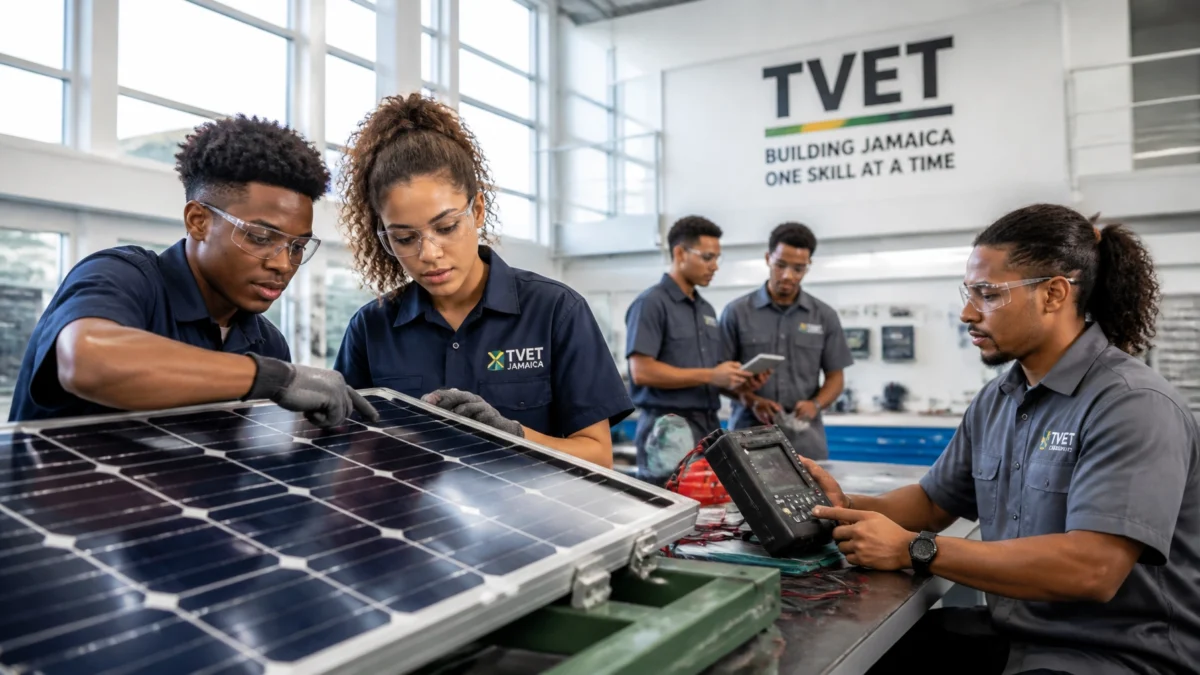
June 29, 2026
1. Introduction: The “Graduation Illusion” and the Caribbean Skills Crisis
For decades, Caribbean education systems have been trapped in a “knowledge-based” loop. We have excelled at producing graduates who can pass exams but are paralyzed when faced with the actual technical demands of a 21st-century workplace. This “Graduation Illusion”: the belief that a certificate equivalent to a memorization marathon equals workplace readiness: is currently the single greatest threat to our regional economic stability.
As we stand in June 2026, the gap between what our schools teach and what our industries need has become a chasm. Across the Caribbean, the demand for “competency-bred” graduates is at an all-time high. Yet, many Technical and Vocational Education and Training (TVET) programs are still operating on 20th-century blueprints.
The reality is stark: if you are not training workers who can do, you are not training workers at all; you are simply managing unemployment.
2. The Problem: A System for Sale to Yesterday’s Demands
The shift toward Competency-Based Education and Training (CBET) is not a suggestion: it is a survival mandate. However, the transition in the Caribbean is being throttled by three major failures:
- Institutional Fragmentation: In countries like Trinidad and Tobago, as noted in recent IDB situational analyses, the TVET landscape is a mess of overlapping jurisdictions, declining resources, and a total absence of a comprehensive Labour Market Information System (LMIS). Without data, governance is just guesswork.
- The Social Stigma: TVET is still unfairly branded as a “second-rate” option for those who couldn’t succeed in the academic stream. This stigma keeps our brightest minds away from the very trades: renewable energy, digital animation, and agro-tech: that will define our future.
- Funding Blind Spots: We are seeing a lack of sustainable financing models that integrate private sector investment with public policy. Programs are too often dependent on external grants rather than a robust, employer-driven TVET levy system.
- Data Systems That Cannot Drive Reform: Many institutions still lack the statistical backbone to connect enrolment, training quality, labour demand, accreditation, and employment outcomes. That is exactly why labour market diagnostics and statistical system reform matter. Without credible labour market intelligence and data governance, TVET reform remains political rhetoric rather than operational reality.
At Dunn Pierre Barnett and Company Canada Ltd (DPB Global), we see these systemic cracks every day. This is not abstract for us. Across the Caribbean, institutions are struggling to modernize governance, labour market systems, statistical capacity, and reform execution all at once.
We are currently witnessing a Caribbean economy that is hungry for the Green, Blue, Digital, and Orange (creative) sectors, yet the workforce is still being “prepared” for jobs that are being automated out of existence.

3. Five Ways to Modernize TVET Programs Now
I. Institutionalize a “Data-First” Labour Market Information System (LMIS)
Modernization begins with evidence. You cannot fix what you cannot measure. Governments must move beyond static, five-year-old census data and adopt real-time AI-driven analytics.
DPB Global specializes in building structured Labour Market Information Systems (LMIS) that track employment trends, wage fluctuations, and skills demand in real-time. By utilizing our Statistical Analysis capabilities, institutions can forecast exactly which skills will be needed six months from now, rather than reacting to what was needed six years ago.
II. Adopt CBET: Replace “Seat Time” with “Mastery”
The revised CARICOM Regional TVET Strategy is clear: we must convert all programs to a standards-based CBET modality. In a CBET system, a student doesn’t progress because the semester ended; they progress because they have demonstrated mastery of a specific skill.
Jamaica’s HEART/NSTA Trust and Barbados’s TVET Council have led the way here, but the rest of the region must accelerate. This requires updating the Regional Occupational Standards (ROS) to include Critical Employability Skills (CES): ICT, problem-solving, and collaboration: as mandatory competencies, not elective afterthoughts.
III. Pivot to the “Four Economies”: Green, Blue, Digital, and Orange
Modern TVET must align with regional economic transformation.
- Green: Training for photovoltaic installation and climate-resilient agriculture (as seen in the SAGE programme).
- Blue: Fishing vessel operation and maritime logistics.
- Digital: Cybersecurity, AI-integration, and data management.
- Orange: Animation and creative arts.
If your TVET program is not actively certifying workers in these four pillars, you are effectively training them for obsolescence.

IV. Regional Harmonization and Worker Mobility
A Caribbean worker certified in Grenada must be recognized in Guyana. The Regional Vocational Qualifications Framework (RVQF), administered through CANTA, is the engine of this mobility. We need to stop protecting national “turf” and start protecting regional “talent.” This includes the implementation of Prior Learning Assessment and Recognition (PLAR), allowing experienced workers to have their informal skills formally certified without being forced back into a classroom for three years.
V. Eradicate Stigma through Private-Sector Integration
The only way to kill the stigma of TVET is to make it high-paying and high-status. This requires the private sector to move from being a “consumer” of skills to a “co-producer.” Employer-based training, apprenticeships, and Sector Skills Councils are the only way to ensure that curricula remain relevant. When industry leaders sit on the boards of TVET institutions, the quality: and the perception of that quality: skyrockets.
VI. Build Reform That Can Actually Last
Modernization is not a workshop. It is not a policy memo. It is not a ribbon-cutting exercise. It is system redesign.
That means governments and institutions need implementation architecture that connects labour market intelligence, curriculum reform, governance modernization, quality assurance, employer engagement, and financing. If these pieces are treated as separate conversations, reform stalls. If they are designed as one system, TVET starts producing workers who are adaptable, certified, and ready for the economies that are already taking shape.

4. What DPB Global Has Done: Real Projects, Real Results
At Dunn Pierre Barnett and Company Canada Ltd (DPB Global), we do not approach Caribbean TVET reform as outside commentators. We build the architecture of change through consulting, labour market analysis, statistical systems strengthening, competency-based reform, and workforce development.
Our regional and international experience includes:
- Guyana (2025): Strengthening Human Capital through Education Project — institutional strengthening of the Guyana TVET Council, including governance reviews, quality assurance frameworks, and workforce development alignment with emerging economic sectors.
- Saint Lucia (2024): National Labour Market Needs Assessment — identified workforce demand, skills shortages, and sectoral gaps that informed TVET reform recommendations.
- OECS (2024-2025): Regional Statistical Capacity Building Strategy — designed a five-year strategy for national statistical systems, data governance, and evidence-based policymaking.
- Saint Lucia (2025): Client Satisfaction Survey — delivered statistical analysis under the Performance-Based Financing Programme, reinforcing our capability to produce decision-grade evidence for institutional improvement.
- CARICOM CLE Curriculum Reform Project (2026) — supporting regional legal education modernization through competency-based frameworks.
- National Skills Audit, Guyana (2024) — providing direct skills intelligence to support workforce planning and reform.
The scale matters. DPB Global has delivered 123+ TVET and skills consultancies across 40+ countries, completed 300+ projects in 40+ countries, and conducted 160+ surveys. Our client portfolio includes the United Nations, World Health Organization, Pan American Health Organization, British Government, Caribbean Development Bank, and the World Bank.
We are a premier full-service consulting firm specializing in Technical Vocational Education and Training (TVET), Competency-Based Education and Training (CBET), Labour Market Research and Social Surveys, and Workforce Development. With global expertise in Instructional Design, Management Consulting, Capacity Building, and Business Development, we maintain one of the world’s largest databases on Black Data and populations in the Global South, providing expert insights and AI-driven analytics to support diverse communities, governments, and organizations across Canada, Africa, and the Americas.

5. Call to Action: Modernize or Be Left Behind
The Caribbean cannot afford to wait. Every year we delay the full implementation of CBET and the modernization of our TVET governance is another year we lose our most valuable resource: our people: to migration or underemployment.
Is your institution ready to produce the “competency-bred” graduates of tomorrow? Do you have the data to back your decisions?
Partner with DPB Global today. Let us provide the statistical rigor and strategic consulting needed to turn your TVET program into an engine of regional prosperity. Visit us at dpbglobal1.com to start the conversation.
About the Author: Dr. C. Justine Pierre, Dunn Pierre Barnett and Company Canada Ltd (DPB Global), specializing in labour market trends, data-driven policy, and economic justice for BIPOC communities globally.
About DPB Global: Dunn Pierre Barnett and Company Canada Ltd (DPB Global) is a premier full-service consulting firm specializing in Technical Vocational Education and Training (TVET), Competency-Based Education and Training (CBET), Labour Market Research and Social Surveys, and Workforce Development. With global expertise in Instructional Design, Management Consulting, Capacity Building, and Business Development, we maintain one of the world’s largest databases on Black Data and populations in the Global South, providing expert insights and AI-driven analytics to support diverse communities, governments, and organizations across Canada, Africa, and the Americas. Visit us at dpbglobal1.com.