

The Heavy Lifter: Why Guyana’s economic Boom depends on the National Skills Audit
March 31, 2026
Digital Geofencing Framework for Electoral Engagement in Grenada, Dominica, and Antigua and Barbuda (2026–2028)
March 31, 2026By Dr. Justine C. Pierre
1. Introduction: The Statistical Mirage of the Caribbean
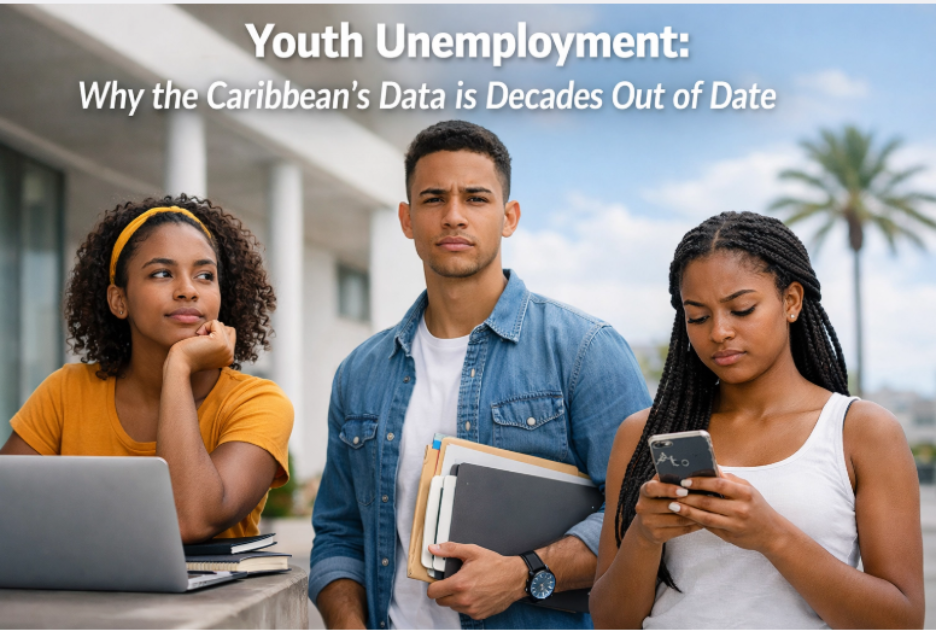
The Caribbean is currently navigating a 21st-century economic hurricane using a map drawn in the 2010s. While regional leaders frequently cite “record-breaking tourism numbers” and “recovering GDP,” there is a silent, growing crisis that these headlines conveniently ignore: the systemic failure to accurately measure and address youth unemployment.
In the OECS and the wider CARICOM region, youth unemployment rates remain stubbornly elevated, often double or triple the national averages even as overall labour markets show post-pandemic recovery. According to the latest International Labour Organization (ILO) analysis, the youth unemployment rate across the Caribbean (excluding Haiti) stood at 17.6% in 2024, compared to just 4.7% for adults aged 25 and over — a gap that has marginally widened since 2010. When Haiti is included, the regional youth rate jumps to 30.5%.
Table 1: Caribbean Youth Unemployment Trends (Caribbean Small States, ILO-modelled estimates)
| Year | Youth Unemployment Rate (15-24) |
| 2021 | 24.1% |
| 2022 | 20.2% |
| 2023 | 19.1% |
| 2024 | 18.8% |
| 2025 (proj.) | 19.1% |
Source: World Bank / ILO via FRED (Caribbean Small States aggregate)
National data from the Caribbean Development Bank’s 2024-2025 Economic Review paint an even starker picture in individual territories. Youth unemployment hovers around 20% in Saint Lucia, Grenada, and Barbados; near 18% in The Bahamas and Jamaica; and around 15% in Trinidad and Tobago and Belize, while overall national unemployment has fallen to single digits in most countries. The widest gaps (exceeding 10 percentage points) appear in Belize, Jamaica, Grenada, The Bahamas, and Barbados.
Table 2: Selected Caribbean Countries – Youth vs. National Unemployment (approx. 2024, CDB data)
| Country | Youth Unemployment | National Unemployment | Gap |
| Saint Lucia | 20% | Single digits | 10 pp |
| Grenada | 20% | Single digits | 10 pp |
| Barbados | 20% | Single digits | 10 pp |
| Bahamas | 18% | Single digits | 10 pp |
| Jamaica | 18% | Single digits | 10 pp |
| Trinidad & Tobago | 15% | Single digits | 0 |
| Belize | 15% | Single digits | 10 pp |
The most provocative truth isn’t just that young people are out of work: it’s that the data we use to “solve” this problem is, in many cases, decades out of date. We are attempting to build a future for a digital-native generation using administrative tools and statistical frameworks that haven’t been meaningfully updated since the era of dial-up internet.
Across the OECS, reliance on infrequent censuses (most last conducted 2010–2012, with many COVID-delayed until 2021–2022) and sporadic Labour Force Surveys remains the norm. Anguilla, for example, conducted its first household Labour Force Survey in 26 years in mid-2025. Saint Vincent and the Grenadines released its latest comprehensive LFS in 2022. Even where quarterly surveys exist (e.g., Barbados), granular youth and skills-mismatch indicators are often extrapolated from older benchmarks. Tourism and GDP figures may be reported monthly or quarterly, but the detailed labour-market intelligence that should guide policy lags by years, if it exists at all.
According to Dr. Justine Cleophas Pierre, Co-Founder and Director of Research and Business Development at Dunn Pierre Barnett and Company Canada Ltd (DPB Global), the region’s reliance on infrequent, antiquated census data is not just a technical oversight; it is a policy failure that “tightens the grip” of poverty on the next generation.
Compounding the statistical mirage is the hidden crisis of NEET (Not in Education, Employment or Training) youth: nearly 24% of Caribbean young people aged 15–24 (excluding Haiti) falls into this category, down only slightly from a 29% pandemic peak. Labour force participation among youth has fallen steadily, from 39.2% in 2000 to 36.4% in 2024, signalling widespread discouragement rather than genuine improvement. Young women face unemployment rates 1.6 times higher than young men, locking in gendered patterns of exclusion.
In short, the Caribbean is celebrating macroeconomic “recovery” with yesterday’s data while an entire generation of digital natives is being left behind. Until the region invests in modern, real-time Labour Market Information Systems, continuous LFS, skills audits, and youth-specific dashboards, the statistical mirage will persist, and the economic hurricane will continue to claim its most vulnerable victims. The map must be redrawn, urgently and accurately, before the next storm hits.

2. The “Archival Nightmare”: Why Census Data Fails the Youth
Why Census Data Fails the Youth, highlights a critical structural flaw in how many Caribbean territories gather and use labour market information. In the region, the decennial census remains the cornerstone for understanding employment trends, demographics, and skills needs. However, the slow pace of collection, processing, analysis, and dissemination renders this data obsolete almost immediately upon release.
For instance, many Caribbean countries conducted their most recent population and housing censuses around the 2020-2022 round (e.g., Saint Lucia and Grenada in 2022, Barbados in 2021, with preliminary and final reports emerging in subsequent years). Labour force details from these censuses often lag even further due to backlogs in tabulation and publication. A young person entering the job market in 2026 in places like Castries (Saint Lucia) or St. George’s (Grenada) is relying on snapshots from 4–6 years earlier, or worse, from the prior 2010 round if newer data hasn’t been fully integrated into policy tools. In fast-evolving small island economies vulnerable to tourism shocks, natural disasters, climate impacts, and global digital shifts, this creates a dangerous disconnect between reality and response.
This “archival nightmare” perpetuates several interconnected failures:
- Skills Mismatches are Invisible: Outdated census figures lock policymakers and educators into yesterday’s job profiles. Youth are still funneled into traditional tourism and hospitality training, roles increasingly threatened by automation, AI-driven booking systems, and post-pandemic shifts toward contactless services—or into clerical and administrative positions diminished by digital tools. Meanwhile, emerging demands in high-growth areas like data analysis, cybersecurity, renewable energy installation (e.g., solar technicians amid regional climate adaptation efforts), software development, and green construction go largely untracked and under-resourced. Regional reports consistently highlight this mismatch as a driver of persistent high youth unemployment (often double or triple adult rates), with graduates holding credentials that no longer align with market needs.
- The Gig Economy is a Ghost: Traditional census methodologies and labour force surveys prioritize formal, structured employment, full-time “9-to-5” jobs with employers, contracts, and payroll records. They systematically undercount or miss the growing cohort of young people in the platform and informal economy. Thousands of Caribbean youths now earn through global freelancing sites (e.g., Upwork, Fiverr), ride-hailing/delivery apps (where available), content creation, e-commerce reselling, or informal digital services. This work is flexible, borderless, and often urban or remote, but it’s largely invisible in decennial counts that rely on household questionnaires focused on “main job” categories. The result? Policymakers underestimate the scale of self-employment and gig participation, leading to blind spots in social protection, skills certification, and taxation frameworks for these workers.
- Policy is Reactive, Not Proactive: With data lags of 5–10+ years, government interventions, such as skills training grants, youth entrepreneurship funds, or sector-specific incentives, are calibrated to solve problems from years ago. For example, programs might still emphasize hotel and tourism recovery post-2020 shocks, even as youth face new barriers like AI displacement or the rise of remote global work. Crises emerging today, such as the accelerating digital divide, climate-related job losses in agriculture/fishing, or the post-pandemic surge in youth NEET rates (not in employment, education, or training), remain unaddressed until the next census cycle. This reactivity wastes resources and deepens frustration among young people who see little evidence that systems are adapting to their lived realities.
Breaking this cycle requires urgent investment in more dynamic labour market information systems (LMIS), including regular, shorter-cycle surveys, real-time digital tracking (where privacy-protected), and integration of platform data from gig apps. Without fresher, more granular insights, Caribbean youth will continue to navigate a labour market guided by echoes rather than evidence.

3. The OECS and the “Small Island Data Gap”
For the Small Island Developing States (SIDS) of the OECS, the data gap is even more acute. The high cost of conducting comprehensive Labour Force Surveys (LFS) often leads to long intervals between data collection points. In the absence of current information, the “Caribbean youth unemployment” narrative becomes one of guesswork.
We see the consequences of this in the migration patterns. When a young person in the OECS cannot find a path to a sustainable career, they don’t just stay unemployed; they leave. This brain drain is a direct result of a labour market that is “blind” to its own talent pool.
At DPB Global, our work across the region: including the National Skills Audit for the Turks and Caicos Islands, Guyana, Saint Lucia, Antigua and Barbuda, Suriname and much more, has revealed that when you actually go to the ground and measure skills in real-time, the reality is far different from the “official” colonial-era statistics. We have found that the demand for specific technical skills often exists, but the bridge between the employer and the youth is broken because the data infrastructure is non-existent.

4. Transitioning to Real-Time Intelligence: The LMIS Solution
The path forward does not lie in conducting more infrequent, resource-intensive surveys that perpetuate data lags. Instead, Caribbean territories—particularly those in the OECS—must shift toward implementing a modern, real-time Labour Market Information System (LMIS). A robust LMIS functions as the central nervous system of the economy, integrating diverse data sources to provide live, actionable insights that connect job seekers, employers, educators, and policymakers in a dynamic environment. Unlike traditional decennial censuses or sporadic Labour Force Surveys (LFS), an LMIS leverages administrative records, employer surveys, digital tracking, and periodic modular updates to deliver timely intelligence on vacancies, skills demand, and emerging trends.
Efforts to establish or strengthen LMIS in the region date back to collaborations between the International Labour Organization (ILO), the OECS Secretariat, and national governments. For example, pilot projects like the Saint Vincent and the Grenadines LMIS (SVG-LMIS) computerized key operations of the Department of Labour while aggregating data from ministries, trade unions, and employers’ organizations. Broader initiatives, such as the Caribbean Labour Market Information System (CLMIS) development project, aim to generate reliable, timely, and internationally comparable data across countries. The OECS has pursued harmonized approaches, including annual core LFS modules with add-ons for specific needs, to enhance sustainability and reduce high survey costs in small island contexts. In Jamaica, the existing LMIS provides job placement, labour market intelligence, and a skills bank, demonstrating features like one-stop shops and efficient data management that align with international best practices identified in UNDP analyses.
To modernize effectively, the Caribbean should adopt proven tools and approaches:
- JOLTS-like Job Openings and Labor Turnover Surveys: Modeled after the U.S. Bureau of Labor Statistics’ Job Openings and Labor Turnover Survey (JOLTS), which releases monthly national and state-level estimates of job openings, hires, and separations (e.g., January 2026 data showed persistent openings in key sectors), a Caribbean adaptation would enable policymakers to track real-time job creation and vacancies. While full JOLTS adoption remains limited in small island states due to capacity constraints, elements could be integrated into national LMIS frameworks through employer surveys or administrative data linkages, shifting from decade-old snapshots to monthly or quarterly diagnostics of labour demand.
- National Skills Audits: Real-time, ground-level assessments bridge the gap between education and market needs, directly reducing youth idleness. In the Turks and Caicos Islands, the 2017 National Skills Audit and Migration Survey—conducted by DPB Global—identified critical mismatches, leading to targeted interventions like mandatory soft skills training programs focusing on communication, teamwork, and problem-solving. Such audits reveal hidden demands in sectors like tourism, construction, and emerging digital fields, enabling curriculum reforms that align training with actual employer requirements and lower skills-related unemployment.
- Digital Economy Tracking: Integrating data from online platforms captures the invisible scope of youth engagement in the global gig and remote-work economy. In Latin America and the Caribbean, surveys indicate that over 10% of workers in select countries (e.g., Dominican Republic, Panama) participated in online gig work as of 2022, with youth disproportionately represented due to flexibility and borderless opportunities. Platform data from sites like Upwork or regional ride-hailing/delivery services could feed into LMIS dashboards (with privacy safeguards), providing insights into freelance earnings, skill demands (e.g., digital marketing, coding), and informal participation often missed by traditional surveys.
In DPB Global’s work on the LMIS and Employers’ Skills Demand Survey in Antigua and Barbuda, direct employer engagement transformed policy discourse. By surveying businesses on current and projected needs, the initiative shifted from assumptions (“we think there is a problem”) to evidence (“we know where the jobs are and what skills are missing”). This real-time input informed training priorities, reduced mismatches, and supported more effective youth employment strategies.
The table below highlights key benefits and examples of LMIS impacts in the Caribbean context:
| Component | Description/Benefit | Regional Example/Data | Impact/Statistic |
| Real-Time Job Vacancy Tracking (JOLTS-style) | Monthly/quarterly data on openings, hires, separations | U.S. JOLTS (adaptable elements); OECS harmonized LFS pilots | Enables proactive policy; contrasts with 5–10 year census lags |
| National Skills Audits | Identifies mismatches between education and demand | Turks and Caicos 2017 Audit (DPB Global) | Led to soft skills mandates; reduced youth idleness via targeted training |
| Employer Skills Demand Surveys | Direct input from businesses on needs | Antigua and Barbuda LMIS/Employers’ Survey (DPB Global) | Moves policy from guesswork to data-driven; improves job matching |
| Digital/Gig Economy Integration | Tracks platform work, remote freelancing | >10% participation in select LAC countries (2022); youth-heavy | Captures informal youth engagement; addresses “ghost” economy |
| Overall LMIS Framework | Centralized, sustainable data system | SVG-LMIS pilot; CLMIS development (ILO/OECS) | Enhances decision-making; supports annual core modules for timeliness |
Transitioning to real-time LMIS intelligence requires investment in digital infrastructure, stakeholder collaboration (e.g., ILO-OECS partnerships), and privacy-protected data integration. By doing so, Caribbean economies can move beyond reactive measures, proactively align skills development with market realities, curb brain drain, and unlock sustainable youth employment growth in a rapidly changing global landscape.
5. The Dangerous Stakes: Data Gaps and Human Trafficking
The lack of accurate data has a darker side. When youth are “off the grid”: neither in school, nor in formal employment, nor captured by national statistics: they become the most vulnerable targets for exploitation.
There is a direct correlation between high, unmeasured youth unemployment and the rise of illicit activities. As Dr. Justine Cleophas Pierre has highlighted in multiple studies on human trafficking in the Caribbean, traffickers thrive in the gaps left by the state. When we do not know where our young people are or what skills they have, we cannot protect them.
The absence of a modern LMIS means we are not just failing to find jobs for our youth; we are failing to safeguard their very lives. The 2019 CARICOM reports and subsequent studies have repeatedly raised major human trafficking issues that are exacerbated by economic desperation and a lack of official oversight.
6. “Stop Training for 2010”: A Call to Action for 2026
Continuing to rely on data that is a decade old, or older means delivering solutions tailored to a labour market that no longer exists. The Caribbean youth of 2026 are navigating a fundamentally different landscape from previous generations. They are increasingly entrepreneurs, content creators, tech-savvy innovators, digital freelancers, and global citizens who leverage remote work opportunities, platform economies, and cross-border digital entrepreneurship. Traditional pathways in tourism, agriculture, or public sector administration no longer suffice as primary options, especially as automation, AI, and climate vulnerabilities reshape industries.
Recent data underscores this shift and the urgency of adaptation. Modeled ILO estimates for Caribbean Small States place the youth unemployment rate (ages 15–24) at approximately 19.1% in 2025, with broader Caribbean figures (excluding Haiti) showing persistent challenges around 17–20% in 2024–2025 reports. In specific OECS contexts, youth unemployment hovers around 20% in countries like Saint Lucia, Grenada, and similar small islands, often double or triple adult rates, with young women facing disparities exceeding 30% in some benchmarks. Youth labour force participation has declined, from 39.2% in 2000 to 36.4% in 2024, partly reflecting extended education but also frustration with limited opportunities. Meanwhile, the gig and platform economy is gaining traction: in Latin America and the Caribbean, freelancing platform usage surged during the pandemic, with ongoing growth in remote gig work among youth. Regional dialogues in 2025 highlighted the gig economy’s role in youth employment, though it often lacks formal support, social protection, or visibility in official statistics.
To empower this generation, DPB Global advocates for immediate, actionable reforms:
- Mandatory Annual Skills Assessments: Every OECS member state should implement annual mini-audits or modular Labour Force Survey add-ons to track rapid technological and sectoral shifts. This would enable timely curriculum updates, moving beyond static training programs aligned with 2010-era demands in hospitality or clerical work toward high-demand areas like digital skills, renewable energy, cybersecurity, and creative industries.
- Private-Sector Data Integration: Governments must forge partnerships with private employers, including tourism operators, tech firms, and platform companies, to share anonymized, real-time hiring and vacancy data. This direct input would reveal emerging needs (e.g., AI-related roles or e-commerce logistics) and bridge the information gap that currently leaves youth disconnected from viable opportunities.
- Regional Data Harmonization: Adopting standardized LMIS frameworks across the OECS and broader CARICOM would facilitate the free movement of skilled persons under protocols like the CARICOM Single Market and Economy. Harmonized data on skills shortages, certifications, and mobility could reduce barriers to intraregional employment and curb brain drain by highlighting regional pathways.
- A Regional Labour Market Information System: Building on existing ILO-supported initiatives like the Caribbean Labour Market Information System (CLMIS) development and OECS harmonized LFS efforts, a unified regional LMIS would aggregate national data into a shared platform for cross-border insights, policy coordination, and proactive interventions.
DPB Global has already pioneered this approach through practical, evidence-based projects. From conducting Black labour market needs assessments in Canada, uncovering disparities in employment access, skills recognition, and systemic barriers for Black professionals, to psychosocial surveys in Saint Lucia’s education sector that identify mental health and support needs among students and educators, our work demonstrates the power of modern statistical tools. These assessments reveal hidden opportunities, address inequities, and inform targeted strategies that create pathways where traditional data suggested none existed. By investing in real-time intelligence and adaptive systems, the Caribbean can stop training youth for yesterday’s economy and start equipping them for the dynamic, digital, and global realities of 2026 and beyond.
The table below summarizes key youth labour market indicators and calls to action, drawing from recent regional sources:
| Indicator/Recommendation | Value/Detail | Time Period/Source | Implication for 2026 Action |
| Youth Unemployment Rate (Caribbean Small States, ages 15-24) | ~19.1% | 2025 (ILO modeled) | Persistent high rates demand annual tracking to prevent further entrenchment |
| Youth Unemployment (Select OECS/Caribbean) | ~20% (e.g., Saint Lucia, Grenada) | 2024–2025 reports (CDB/ILO) | Gendered gaps (young women >30%) require targeted, real-time audits |
| Youth Labour Force Participation Decline | From 39.2% (2000) to 36.4% (2024) | ILO 2025 | Shift to gig/remote work needs digital tracking integration |
| Gig/Platform Economy Engagement | Surging post-pandemic; youth-heavy in LAC | UNDP/ILO 2020–2025 | Private-sector data sharing to formalize and support gig pathways |
| Annual Skills Assessments | Mandatory mini audits recommended | DPB Global advocacy | Align training with current demands (e.g., digital, green skills) |
| Regional LMIS Harmonization | Build on CLMIS/OECS pilots | ILO/OECS ongoing | Enable skilled mobility and reduce brain drain |
Implementing these measures is not optional—it’s essential to transform the “archival nightmare” into a responsive, youth-centered future. DPB Global stands ready to support governments, educators, and employers in this transition.
DPBG: Black Data and information Portal

7. Conclusion: The Price of Ignorance
The Caribbean cannot afford the luxury of ignorance. Every day that passes without a real-time understanding of our youth labour market is a day we lose more of our brightest minds to migration or marginalization.
Youth unemployment is not an unsolvable mystery; it is a data problem. By investing in modern LMIS, conducting regular skills audits, and abandoning the reliance on “zombie data” from decades ago, the OECS and the wider Caribbean can finally align their educational systems with the realities of the global economy.
The tools exist. The expertise is here. It is time to stop guessing and start measuring. Our youth are waiting, and they are tired of being invisible.

About the Author:
Dr. Justine Cleophas Pierre is a renowned Labour Market and Political Statistician and the Co-Founder of Dunn Pierre Barnett and Company Canada Ltd (DPB Global). With decades of experience in the Caribbean, North America, and Africa, he specializes in LMIS, human trafficking research, and national skills audits.