
Youth Unemployment: Why the Caribbean’s Data is Decades Out of Date
March 31, 2026
Breaking the Glass Ceiling: One Year of Emmalin Pierre’s Historic Leadership in Grenada
March 31, 2026By Dr. Justine C. Pierre: Labour Market Consultant
By: Dr. Justine Pierre, Labour Market and Political Statistician
Toronto, Canada | March 2026
(When technology meets data)
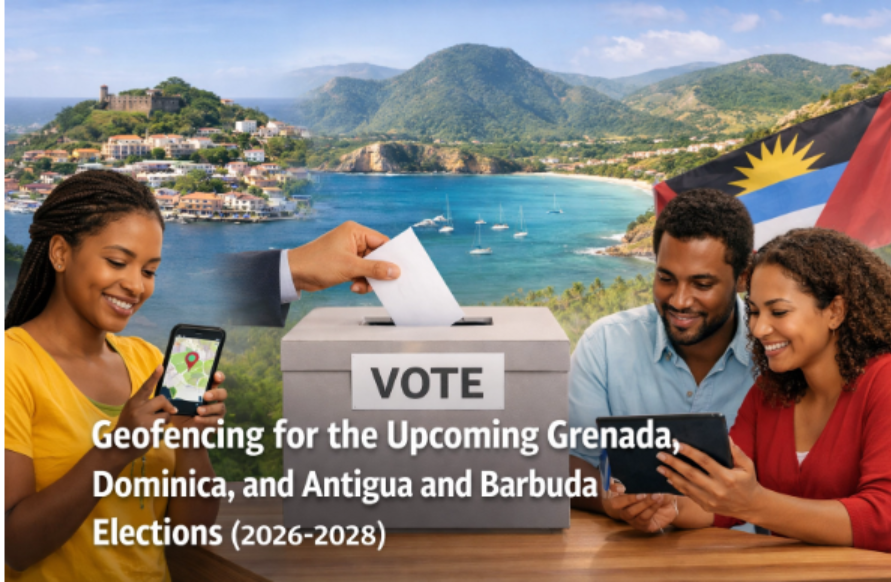
The era of “spray and pray” political advertising is dead. As Grenada hurtles toward the 2026 General Elections, and as Dominica and Antigua and Barbuda prepare for their upcoming cycles through 2028, the political landscape is no longer just about who has the loudest megaphone or the biggest motorcade. It is about who has the most precise data and the technology to deploy it.
At Dunn Pierre Barnett and Company Canada Ltd (DPB Global), we have seen the shift firsthand: the battle for the ballot has moved from the general public to the individual smartphone. The secret weapon for the 2026-2028 election cycle? Geofencing.
This location-based service is not just a marketing gimmick; it is revolutionizing psephology: the scientific study of elections and voting trends. By creating virtual boundaries around physical spaces, campaigns can now target voters with a level of precision that was historically impossible. In a region where every vote counts: and where elections can be decided by a handful of ballots: this technology is the difference between a landslide victory and a crushing defeat.
1. What is Geofencing? The Digital Perimeter of Power
Geofencing is a sophisticated technology that uses GPS, RFID, Wi-Fi, or cellular data to trigger a specific programmed action when a mobile device enters or leaves a virtual geographic boundary. Imagine a voter walking into a specific town hall, a popular local mall, or even a rival candidate’s rally. The moment they cross that invisible line, their smartphone becomes a portal for your campaign’s message.
In the realm of high-stakes politics in the Caribbean, this means delivering targeted messages, notifications, or reminders directly to voters’ devices in real-time. It is the ultimate tool for hyper-local engagement, ensuring that the right message reaches the right person at the exact moment it is most relevant. Whether it is a reminder of a candidate’s record on labor reform or a prompt to visit a nearby polling station, geofencing ensures your campaign is “present” without being intrusive.

2. How the Technology Operates: A Three-Step Execution
To the uninitiated, geofencing feels like magic. To the experts at DPB Global, it is a calculated, three-step technical execution:
- Define the Boundary: Campaign strategists set a virtual perimeter: a “fence”: around a strategic physical location. This could be a specific neighborhood, a polling station, or a community center.
- Device Detection: As a user crosses this boundary with a mobile device, the system detects their presence via GPS or IP address.
- Targeted Action: Once detected, the system triggers a pre-programmed action. This could be a push notification inviting them to a nearby speech, a video highlighting a candidate’s local achievements, or a simple, urgent reminder to vote.
For a comprehensive look at how we integrate this into broader strategies, our work often mirrors the depth found in our National Skills Audit for the Turks and Caicos Islands, where precision data collection is the foundation of every recommendation.

3. The Strategic Benefits: Why Geofencing Wins Elections
The adoption of geofencing offers three primary advantages that traditional media: like billboards or radio ads: simply cannot match:
Hyper-local Targeting
We no longer need to waste resources broadcasting a message to the entire island when only a specific parish is in play. Geofencing allows campaigns in Grenada, Dominica, and Antigua and Barbuda to reach voters in micro-locations, significantly increasing engagement and, ultimately, voter turnout.
Real-time Feedback
Modern campaigns are living organisms. Geofencing provides data on how many people entered a zone, how many interacted with the message, and how they moved afterward. This allows strategists to adjust campaign tactics on the fly. If a rally in St. George’s isn’t converting digital engagement, we pivot in minutes, not days.
Cost-effectiveness
Political capital is finite. Geofencing reduces advertising waste by focusing exclusively on high-potential areas and demographics, ensuring every dollar spent is a dollar aimed directly at a potential vote. This efficiency is critical for smaller Caribbean nations where campaign budgets must be stretched for maximum impact.


4. Strategic Applications for Grenada, Dominica, and Antigua and Barbuda
DPB Global has identified several key applications for location-aware voting technology that will define the 2026-2028 elections:
- Rally Targeting and Re-engagement: Political rallies are high-energy events, but the energy often dissipates once the music stops. Geofencing allows a campaign to “capture” the digital IDs of everyone at a rally. Following the event, the campaign can re-engage these proven supporters with follow-up messages, donation links, or volunteer sign-up forms.
- Neighborhood Turnout Optimization: In areas identified by our Public Intelligence models as having low historical turnout but high potential for a specific party, geofencing can be used to send “Get Out The Vote” (GOTV) reminders only to those residents, providing them with the location of their specific polling station.
- Opposition Mirroring: This is a bold, confrontational tactic. When an opposition candidate holds an event, a savvy campaign can geofence that location to deliver counter-messaging or “fact-check” notifications to the attendees’ phones in real-time. It effectively allows a party to “invade” a rival’s space without physically being there.

5. The 2022 Case Study: When the Data Proved Right
At DPB Global, we don’t just theorize; we prove our methods through rigorous application. In 2022, geofencing was utilized for the first time in a Caribbean general election to predict the results in Grenada.
The stakes were immense. Using our proprietary technology and statistical modeling,
we predicted an election result of 9 seats to 6 in favor of the NDC over the NNP.
The precision was staggering. Not only was the seat count accurate, but the data-driven model was within 50 votes of the actual outcome. This wasn’t a lucky guess; it was the result of the intersection of cutting-edge technology and deep labor market and social intelligence. This level of accuracy is why governments and international agencies seek our Consultancy Services. Our ability to understand the movement of people: whether it’s skilled workers across CARICOM or voters across a parish is unmatched.

6. Challenges and the Ethics of Precision
With great power comes the responsibility of ethical oversight. As we look toward the 2026-2028 cycle, we must address the challenges inherent in high-tech campaigning:
- Scale vs. Precision: Strategists must find the “sweet spot” between targeting a single building and covering an entire district. Too broad, and you lose the benefit; too narrow, and your audience is too small to move the needle.
- Privacy Concerns: At DPB Global, we advocate for transparent, opt-in data collection. Voters must feel informed, not “hunted.” Ensuring data privacy is paramount to maintaining public trust in the democratic process.
- Digital Gerrymandering: There is a fine line between persuasion and manipulation. We must avoid creating “information silos” where voters only see selective, polarized information that prevents them from making a fully informed choice.
Our firm has a long history of addressing complex social issues with gravity, from human trafficking studies to psychosocial support services. We apply that same ethical rigor to political data.

The Future: Location-Aware Voting
The future of psephology is undeniably location aware. As mobile penetration in the Caribbean continues to climb, the smartphone will become the primary battleground for the hearts and minds of the electorate.
Grenada, Dominica, and Antigua and Barbuda stand at a crossroads. The candidates who embrace the marriage of technology and data will have an insurmountable lead over those who rely on the tactics of the 1990s. Geofencing enables campaigns to reach voters at the precise moment they are most receptive to information, turning passive observers into active participants.

Dunn Pierre Barnett and Company Canada Ltd remains at the forefront of this movement. Our multidisciplinary team: ranging from data scientists to political analysts is uniquely positioned to bridge the gap between complex technology and winning campaign strategies.
Are you ready to harness the power of geofencing for your 2026-2028 campaign?
Do not leave your political future to chance. In a world of digital precision, data is the only currency that matters. Contact DPB Global today to lead the charge into the future of Caribbean politics.
Contact Us: www.dpbglobal1.com
Learn more about our team: About DPB Global
Explore our impact: Our Clients